
A Return To The Alps...
...or: when The Peak, though preferably pointy, is not itself The Point.

Hello,
There are lots of new subscribers here. A very warm welcome to you all – and thank you for giving some time to what I have to say. I hope you find it worthwhile. You may want to read about the genesis of all of this here and here. Or you may want just to join in mid-flow.
Writing aside, I’m also now offering life coaching related to moving forwards after hard things – no need to have any interest in mountains, just a willingness to explore, and ideally then commit to, ways of finding the next section of your path. Drop me an email if you’d like to chat about how that works.1 There’s no expectation that you have any idea what direction to go in - the not knowing is usually part of it. (And I’ll have a new website when I reach that point on my priority list, but it’s not up and running quite yet.)
But to this post – and the realities and metaphors of a return to the Alps:
It was last Thursday…
… 3AM …
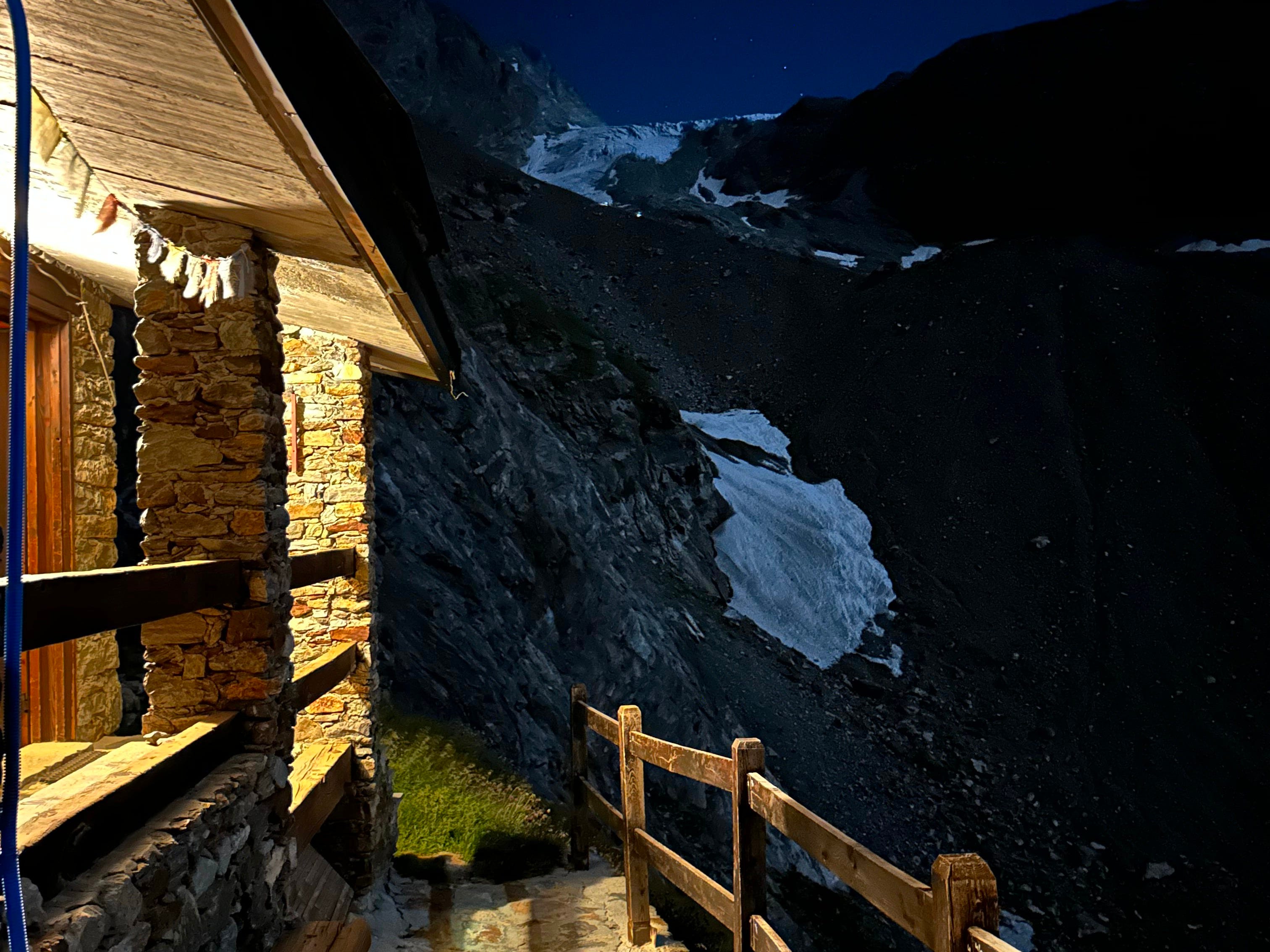
and I was sitting on the splintered wooden veranda of a hut high in the Italian Alps. I should have been sorting my gear – doing the final check for the day ahead. Crampons, harness, carabiners, prussiks, ice screw; food, water, layers. Rope into the rucksack. Ice axe strapped onto the outside. Sunglasses. Suncream: put it on now so I don’t have to stop when the sun comes up. Helmet? Sun hat? Okay, let’s go.
That’s what I’d planned to be doing. Instead, I was merely sitting there, looking at the hut, the ground, and the sky.
‘Get out there; climb that mountain’ – that’s what the motivational speakers say.
But though I’d walked all the hours to the hut I knew I wasn’t going up the Dent d’Herens that morning. I knew that what I needed was something else.
It was, that day, my fifth morning of a week-long attempt at returning to Alpine mountaineering. It was just over five years since the (Alpine mountaineering) accident which my husband, Matthew, and I had had together; and in which he was injured; and following which he died.
My plans for this return trip had been deliberately, appropriately cautious. Not challenging independent ascents, but a near-beginner course2; run by people who had known and climbed with Matthew; somewhere I didn’t have to explain myself if I wobbled or cried. At the beginning of the week I’d been welcomed warmly by the guides. I hadn’t told the other clients what the backstory was.
And so far everything had been roughly as expected. Day one, a walk into a high mountain hut. Day two, the ascent of the peak accessed by that hut – in this case Mont Vélan, in the Swiss Valais. The route was technically very easy; but I was unacclimatised, and nervous with memories on the loose rock, and so it felt hard, and the ridge towards the summit was apparently interminable.
Halfway up that ridge, rope tugging ahead of me, lungs constricting with lack of oxygen, I had a few minutes of wanting just to plonk myself down on a pile of the chossy gneiss and cry.
Why am I here? What was I thinking? Why did attempting to be in the Alps seem like a good idea? Is returning to the site of my grief a complete mistake? Shouldn’t I just accept an easier, smaller life? What would happen if, right now, I just gave up?
Unaccustomed altitude. Hard physical effort. Memories of Matthew, of the accident, of happier, easier, times.
(I didn’t sit down; but for a few minutes, and safely hidden behind my sunglasses, I did cry.)
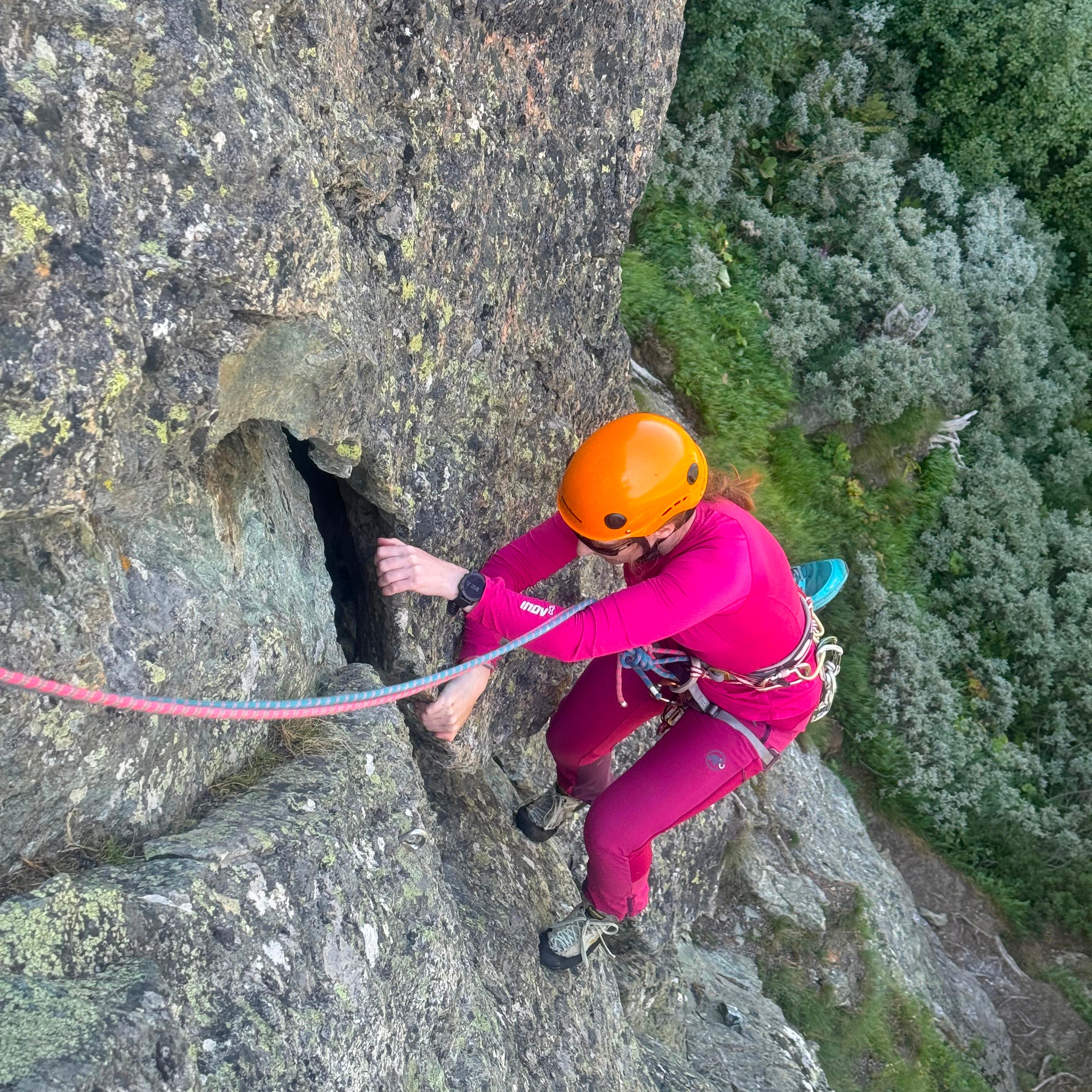
But then we summited Mont Vélan, and by the time we were descending through the crevasse fields I was happy again. That evening – still day two – we walked the long track back down from that hut. Day three, we went multipitch rock climbing in the valley bottom.
That was the first few days. And then we’d driven up high again, and walked for five hours to get higher, and we were aiming for the West Ridge of the Dent d’Herens.
It’s quite a peak, the Dent d’Herens, and it’s one I’ve never been on. It’s well over four thousand metres, which is the magical line of real height in the Alps. It’s superbly positioned: right next to the Matterhorn, and across the valley from the glorious Dent Blanche. (Panoramic views from the summit are part of why we climb.) The route was ‘airy’, said the guidebook, which means, well, that at points the only thing beneath your feet is a lot of hundreds of metres of air.
The West Ridge should have been exactly my sort of route - easy for me, in fact. And yet as I lay in my dorm bed at midnight – calm, rested, aware of all the sleeping bodies around me and the full moonlight on the landscape outside – I knew that this day I was staying at the hut.
‘Are you sure you’re okay?’ Dave asked, as in the 3AM darkness he prepared to set off with my fellow client.
‘I’m super relaxed,’ I replied.
I was. There’d been no angst in my decision-making. I was confident in what I wanted. I wasn’t regretful, or irritated with myself, or scared, or embarrassed, or sad about an opportunity missed.
What I wanted that day was not a summit. It was something different.
And so off Dave went. I watched his headtorch disappearing up onto the glacier, along with those of the Swiss and Italian men with whom I’d shared the dorm. And I sat on the rough, splintered hut veranda.
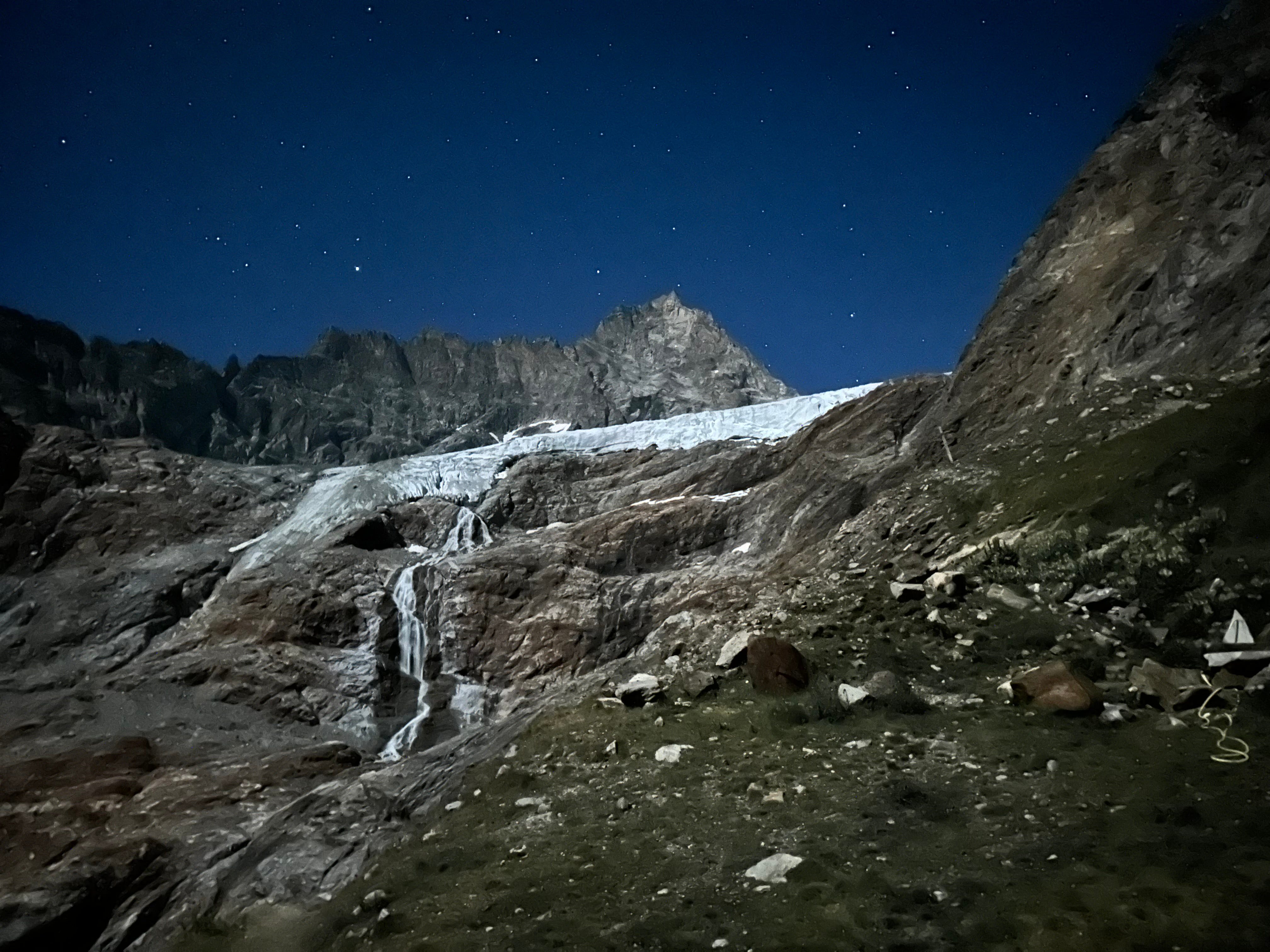
I sat there in fact for six hours. To start with there were stars and a near-full moon, and then the stars faded, and as the moon set the sky began to brighten from the east. Sunlight came sharp out of the growing blue, and progressively it cut its way down the slopes to my right, until first the crude veranda rail, and then the bench I was sitting on were hot. I moved myself off the bench and onto the ground, lying with my upper back pressed against the slanted cover of the wood store, with the cold of the flagstones striking up into my thighs. Water was rushing off the glaciers.
Matthew, I thought. My darling Matthew. And the mountains. Grief. How I’ve handled the past five years of finding a new life. The Alps this year. This mountain. I thought of all of that. Mostly, though, my brain was, comfortably, relaxedly, blank.
‘You’re a human doing,’ a counsellor, Elmer, said to me many years ago. ‘And you need to become a human being.’
I thought of Elmer as I sat on the veranda of the Rifugio Aosta, doing nothing, being everything, sitting alongside but not feeling absorbed by my sadness. Looking at the view, I wanted to tell Elmer, ‘I get it now.’
And all the time the sun was sliding round towards the south. And there was real heat now, bouncing back off the rough wall behind me. And still the rush of the glacier waterfalls.
At some point the gruff hut guardian, surprised to have someone here at this hour, opened a window from his inner sanctum, stuck out a sunburned hand, shook mine, and then handed a complementary espresso through.
‘Come si chiama?’
‘Mi chiamo Kate.’
‘Sono Diego.’
And we chatted away contentedly for a while, sipping coffee, admiring the landscape – both of us entirely unfazed that my sleep-deprived Italian was pidgin at best, and his was so thickly accented I could barely make out one word in three.
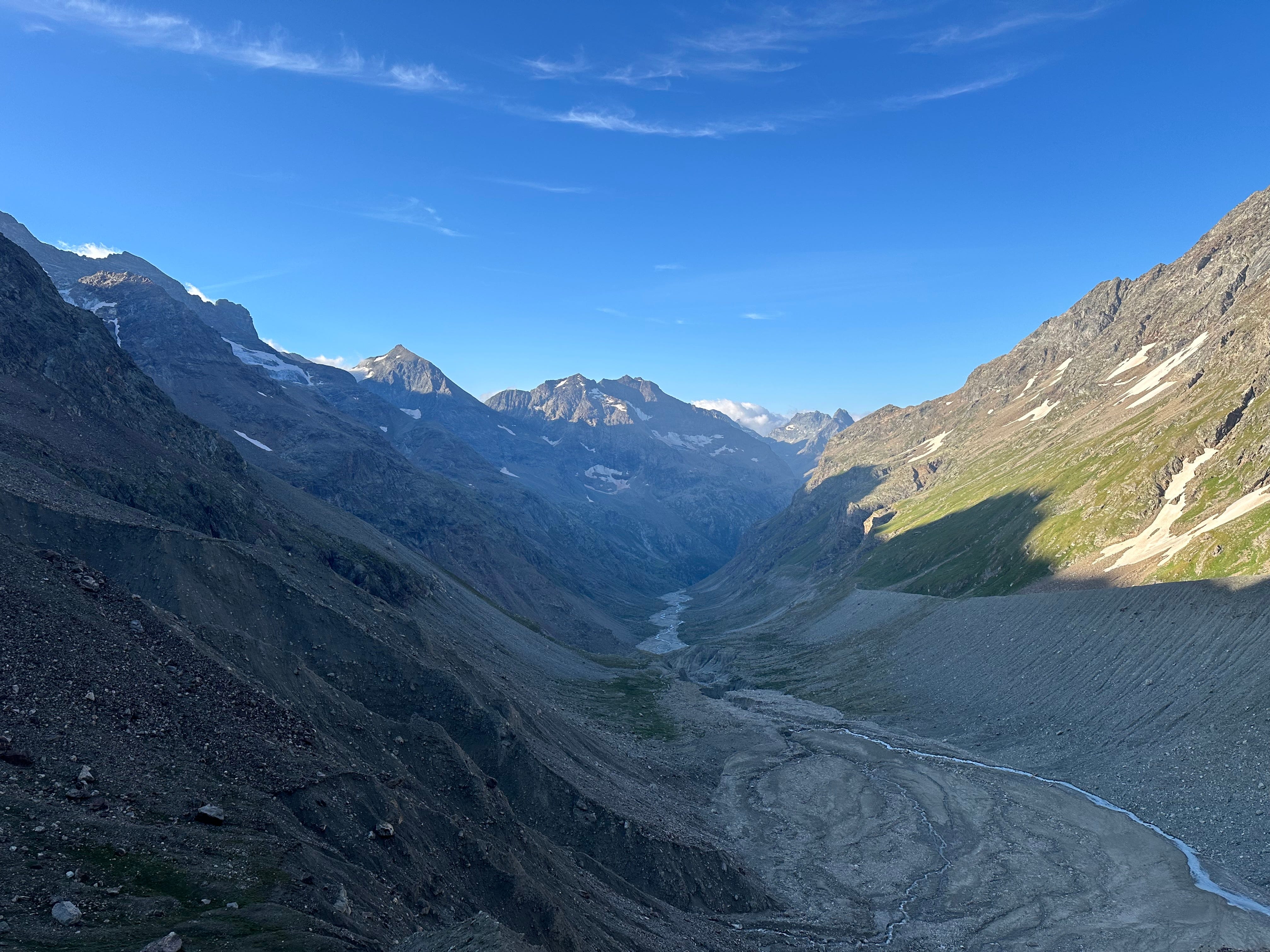
And so I didn’t climb the Dent d’Herens. I did better that day than climbing the Dent d’Herens. I gave myself what I most needed. A space to be with myself, and my grief, and my hope for the future. A big, wide, glacier-formed space.
Descending from the hut in the afternoon, I not only overflowed with energy and with enjoyment; I also knew I’d re-found a part of myself – a high Alpine part – that I’ve been sorely missing these past five years.
I’ll go back, I imagine. The Dent d’Herens is a peak I’d like to climb.
In the meantime, though, Beyond The Mountain is also ‘being in the mountains’; ‘being with the mountain’; ‘returning to the mountain’.
Love to you all, as always,
Kate
PS, and for a full contrast: while I was at the Rifugio Aosta deciding not to go up the Dent d’Herens, an internet-familiar face appeared at the door. It was Kilian Jornet, the world’s best trail-running mountaineer – on an attempt to climb as many of the Alpine 4,000m peaks as possible in a single self-propelled journey. The previous day he’d climbed 18 of them (for reference that particular set should typically take a fit mountaineer a week or so). I’m not sure I’ve ever been so starstruck. If you too want to be knocked backwards in awe, then you can read about his journey here.
I have training and qualifications for this, and am an associate of the International Coaching Federation. If you’re potentially interested, let’s chat.
These things are relative; but it’s the level of course I first did back in 2008, so a fair amount of time ago. And latterly most of my Alpine climbing had been done independently, without guides, so that was an extra precaution as well.
This, the story of the decision to stay back, to sit with oneself, to not do, is such an important one to tell. Precisely because it's very rarely told.
I love this, thank you for sharing. It’s a very special reminder that hard things, grief, illness etc guide us to be more ‘being’ and through that to relate to landscapes in a whole new way. I think not going to the summit is the bravest of all decisions.